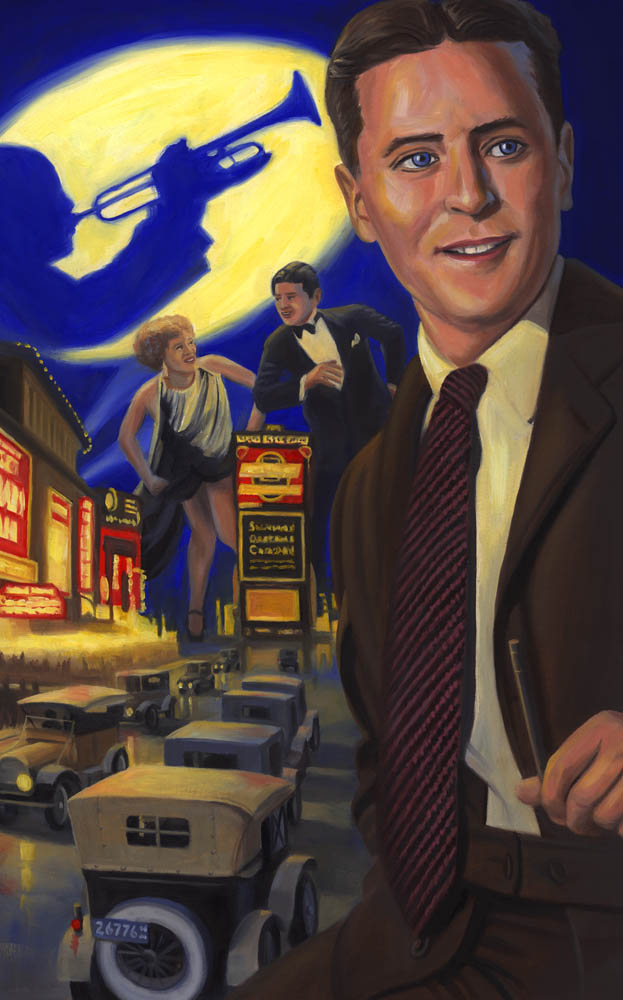
Francis Scott Key Fitzgerald, better known as F. Scott Fitzgerald, was born in St. Paul, Minnesota, on September 24, 1896. He's considered one of America's greatest, well-known, and admired writers. Fitzgerald is held in high regards and is most recognized for his renowned pieces of works such as "The Great Gatsby," a novel about the ever elusive American Dream in the 1920's/jazz era, an era that Fitzgerald experienced first hand. Like any other author, it's safe to say Fitzgerald's writings were influenced by his major events in his life.
F. Scott Fitzgerald attended St. Paul Academy during his early teenage years; it was there, at the age of 13, Fitzgerald first appeared in print, in the
St. Paul Academy Now and Then. Two years later, his parents sent him to The Newman School, a Catholic preparatory institution in New Jersey, where he met Father Sigourney Fay, who recognized Fitzgerald's talents and encouraged his drive and determination for personal distinction and accomplishment. In 1913, F. Scott Fitzgerald joined the 1917 class of Princeton University; he became active with the likes of school literary establishments such as The Princeton Tiger humor magazine and The Triangle Club. In fear of flunking out, Fitzgerald joined the army in 1917 and wrote his first novel entitled "The Romantic Egoist;" however, when he submitted it to Charles Scribner’s Sons, he received a letter rejecting the novel but applauding the novel's originality. The letter did, however, encourage him to revise the story and resubmit it afterwards.
Not long after his rejection from Charles Scribner’s Sons. Fitzgerald was positioned near Montgomery, Alabama, where he ended up meeting Zelda Sayre; the two quickly became an item.
It was meeting Zelda that inspired him to revise
The Romantic Egoist and submit the novel once again, however, Charles Scribner’s Sons turned down the novel a second time. In 1918 the war ends, he heads to New York, and unwilling to wait for Fitzgerald's success, Zelda broke off their engagement. A year later, he moves back to St. Paul and rewrites T
he Romantic Egoist; editor Maxwell Perkins of Scribners accepts the new manuscript—now entitled
This Side of Paradise. On March 26, 1920,
This side of Paradise is published; one week later, Fitzgerald and Zelda marry.
After vigorous traveling, writing another booking, and having a child, the couple moved to Great Neck, Long Island; this place helped inspire the setting and mood for
The Great Gastby. By this time Fitzgerald already struggled with alcoholism, but he wrote sober.
While The Fitzgeralds were in France in 1924, F. Scott wrote
The Great Gatsby; he then revised the script in Rome between 1924-1925. When en route back to Paris in April, the novel was Published. The reviews received critical praise, but unfortunately, the sales didn't reflect the popularity that is now
The Great Gatsby. After the release of this novel, Fitzgerald wasn't as successful in the rest of his endeavors. He made attempts at writing another novel and screenwriting but those too did not pan out to be as triumphant.
F. Scott Fitzgerald's life was hands down influenced by all of these major events in his live and the people he met along the way: his work was printed at an early age (even if it was in a school paper), he met Father Sigourney Fay who encourage him dearly, his wife inspired him, his friendship with Ernest Hemingway could only have been beneficial seeing he was a great author as well, being turned down by Charles Scribner’s Sons helped him write the best manuscript possible. These life events are what made F. Scott Fitzgerald, F. Scott Fitzgerald.